
RIGOL DHO924S
4.5Editor score
250 MHz bandwidth
Built-in signal generator
High-resolution touch display
Digital oscilloscopes are essential tools for engineers and hobbyists needing to visualize electrical signals. They provide detailed insights into voltage changes over time, helping diagnose issues in circuits and systems effectively.
We compared ten models based on bandwidth, sampling rates, and usability features. Each option was selected for its ability to deliver accurate readings and user-friendly interfaces across various professional and educational scenarios.
Every pick highlights key strengths and potential trade-offs to match your specific needs. Please note that product availability and pricing may change over time, so verify current details before purchasing your device.
4.5Editor score

4.9Editor score

4.4Editor score
As an Amazon Associate we earn from qualifying purchases.
The table below offers a side-by-side view of technical capabilities. It highlights key differences in bandwidth, channel count, and special functions to help you compare these ten options quickly.
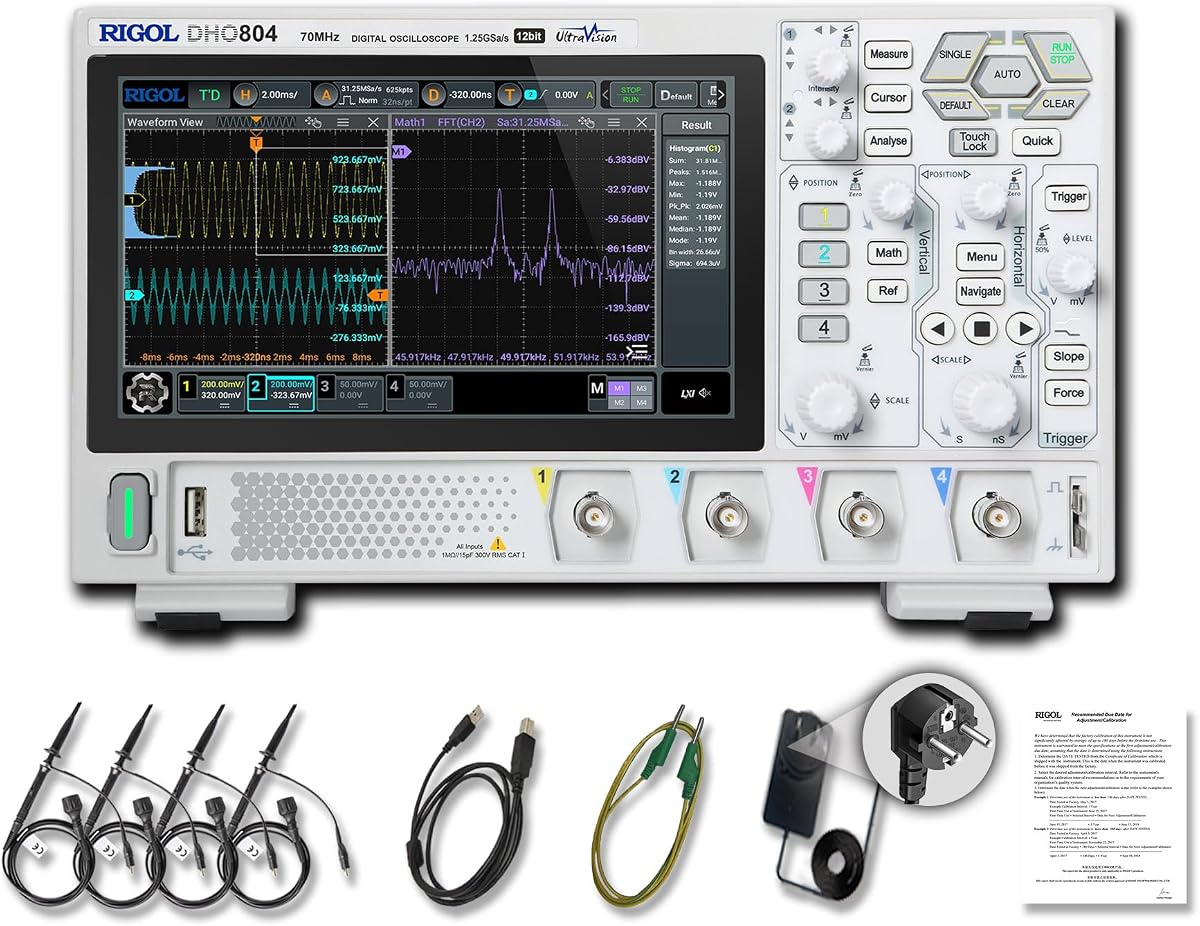


The RIGOL DHO804 is a high-quality digital oscilloscope designed for portable use without sacrificing resolution. It holds a strong 4.3-star rating from users who value precision in their measurements.
We may earn a commission when you buy through this link, at no additional cost to you.
Its standout feature is the 12-bit vertical resolution which provides much finer detail than standard 8-bit units. The four analog channels allow you to monitor multiple voltage rails simultaneously.
The only trade-off is the cost and complexity, but these are acceptable for serious engineers who need reliable data. The deep memory helps capture long sequences without losing detail.
You should buy this if you need a portable device for embedded bring-up or sensor validation. It is recommended for users who prioritize signal integrity.
The 12-bit resolution allows you to see small voltage changes that might be missed on standard units.
UltraAcquire technology helps find intermittent glitches quickly by sorting waveforms by intensity.
We may earn a commission when you buy through this link, at no additional cost to you.
The RIGOL DHO924S is a top-tier choice for professionals needing high bandwidth and extra tools. It holds a 4.5-star rating for its advanced capabilities and reliable performance.
We may earn a commission when you buy through this link, at no additional cost to you.
It includes a built-in signal generator and Bode plot analysis which saves space on the bench. The 250MHz bandwidth ensures you can analyze high-speed signals accurately.
The main downside is the cost and the need for separate digital probes for full functionality. However, these are reasonable trade-offs for such a versatile instrument.
You should buy this if you need to test power loops or high-speed embedded timing. It is the best pick for advanced lab work.
The S model adds a signal generator so you can test response without extra hardware.
Support for CAN and SPI protocols helps with embedded systems validation easily.
We may earn a commission when you buy through this link, at no additional cost to you.
The FNIRSI DPOS350P combines an oscilloscope with a spectrum analyzer and signal generator. It has a 4.1-star rating reflecting its utility for field work.
We may earn a commission when you buy through this link, at no additional cost to you.
Its key strength is the 350MHz bandwidth and the inclusion of a frequency response analyzer. The large battery ensures long field use without frequent recharging.
You might find the interface slower than bench units but this is acceptable for portability. It handles EMI checks well with its FFT features.
Buy this if you need a portable all-in-one for field service or education. It offers great value for the features provided.
The 8000mAh battery allows hours of continuous use during site visits.
Spectrum analysis helps identify noise sources that standard scopes miss.
We may earn a commission when you buy through this link, at no additional cost to you.
The RIGOL DS1102Z-E is a widely recommended benchtop model with near perfect user reviews. It features a 4.9-star rating due to its consistent accuracy.
We may earn a commission when you buy through this link, at no additional cost to you.
Its deep memory and high waveform capture rate make it ideal for finding glitches in long signals. The touch screen and protocol decoding are great for students.
While it lacks four channels the performance is reliable for most general tasks. The value for money here is hard to beat.
You should buy this for general electronics debugging or lab education. It is highly recommended for students and hobbyists.
High waveform rates help you see rare events that would otherwise be missed.
Built-in decoders simplify checking UART or SPI communication lines.
We may earn a commission when you buy through this link, at no additional cost to you.
The FNIRSI 2C53T is an affordable option that combines scope and multimeter tools. It has a 4.3-star rating for its versatility at this price.
We may earn a commission when you buy through this link, at no additional cost to you.
The main strength is having a full multimeter alongside the oscilloscope which saves cost. It is suitable for basic repairs and maintenance tasks.
You may find the sample rate lower than premium units which limits detail. But for the price the utility is quite high.
Buy this if you need a low-cost tool for basic maintenance. It is a good starter unit for schools.
Measuring voltage levels with the multimeter then checking waves on the scope is quick.
Its small size fits in a toolbox for on-site repairs easily.
We may earn a commission when you buy through this link, at no additional cost to you.
The FNIRSI DSO152 is a tiny handheld oscilloscope that fits in your pocket. It has a 4.4-star rating for its simplicity and convenience.
We may earn a commission when you buy through this link, at no additional cost to you.
Its key benefit is its size which makes it perfect for quick checks on the go. The auto setup button makes it very easy to use.
You will notice the bandwidth is limited to 200kHz so it cannot handle fast signals. This is acceptable for basic maintenance and audio work.
You should buy this for quick field checks or as a spare tool. It is highly recommended for hobbyists needing portability.
Weighing very little it can be carried to any repair site without bulk.
One touch auto setup saves time when you just need a quick look.
We may earn a commission when you buy through this link, at no additional cost to you.
The Hantek DSO2D15 is a solid lab oscilloscope with a 4.6-star rating for students. It offers a balance of features for general testing.
We may earn a commission when you buy through this link, at no additional cost to you.
It supports many trigger modes and protocols which is great for learning signal theory. The arbitrary waveform feature helps in testing circuits too.
Some users find the menu system a bit deep which can be slow. But the capabilities are there for most educational needs.
Buy this if you are in a lab setting needing protocol decode. It is suitable for undergraduate engineering courses.
The 14 trigger modes allow students to explore different signal behaviors.
Decoding standard protocols helps verify data integrity in labs.
We may earn a commission when you buy through this link, at no additional cost to you.
The FNIRSI 1013D Plus features a large 7-inch touchscreen for easy interaction. It holds a 4.4-star rating for its user-friendly design.
We may earn a commission when you buy through this link, at no additional cost to you.
Its standout feature is the gesture-based control and waveform management system. You can store many screenshots and data sets on the device.
You might find the performance slightly slower than dedicated hardware units. This is acceptable for general use where convenience is key.
You should buy this if you prefer touch controls and portability. It is good for presentations and field demos.
The 7-inch screen provides clear visibility of detailed waveforms in dark rooms.
Storing up to 1000 screenshots helps track changes over time easily.
We may earn a commission when you buy through this link, at no additional cost to you.
This listing currently shows no detailed product information available for review. We will update this section once verified details are available.
We may earn a commission when you buy through this link, at no additional cost to you.
It is important to verify if this is a discontinued or new model before purchase. Please check the product page for the latest updates.
The lack of data makes it impossible to assess quality or features. We recommend selecting from the verified models above.
You should avoid buying this until full specifications are provided. It is best to choose a rated option.
We are waiting for updated data to provide a fair assessment.
We may earn a commission when you buy through this link, at no additional cost to you.
Selecting the right oscilloscope involves balancing your technical needs with your budget. Below are key factors to consider for making a smart choice.
Bandwidth determines the maximum frequency the scope can measure accurately. You should choose a bandwidth at least five times higher than your signal frequency for precise results.
Higher sampling rates ensure you capture fast signals without aliasing. This is critical when analyzing digital pulses or high-speed switching.
Channels determine how many signals you can view simultaneously. Most basic users can work with two channels but four are better for complex power supplies.
Choose four channels if you need to compare multiple rails or signals at once. This avoids swapping probes and losing context during tests.
Vertical resolution defines how finely the scope can measure voltage amplitude. Standard units use 8-bit resolution but 12-bit models offer significantly more detail.
Higher resolution is essential for measuring small noise or ripple on stable power lines. It helps reveal details that lower units might miss.
Memory depth affects how much data the scope can store per capture. Larger memory allows you to view longer timeframes at high sample rates.
Deep memory is necessary for finding rare glitches or analyzing long sequences. It keeps your analysis consistent over time.
Consider how often you will move the device between locations. Handheld models are great for fieldwork while bench units are better for lab use.
Portability impacts battery life and ruggedness. If you work on-site choose a model with strong battery support and a durable build.
Modern scopes offer LAN USB or Wi-Fi options for remote control. This helps in automating tests or sending data to a PC for analysis.
Web control via browser is a convenient feature for monitoring without extra software. Check if the model supports SCPI commands for scripting.
Built-in protocol decoders save time when debugging serial buses like I2C or SPI. These features interpret the signal into human readable data.
Spectrum analyzers help identify noise frequencies that standard scopes miss. Look for FFT capabilities if signal integrity is a priority.
Touchscreens can make navigating menus faster but traditional buttons are reliable for quick adjustments. Choose based on your preference for speed vs precision.
Interface speed should be smooth enough to handle rapid measurements. A laggy screen can slow down your work during critical tests.
Always connect probes to the ground clip before attaching the signal tip. This prevents accidental shorts and protects the device from voltage spikes.
Regularly calibrate the probes to ensure accurate amplitude readings. Use the calibration output on the scope to verify the probe settings.
Store the device in a dry environment to prevent damage from humidity. Avoid dropping handheld units to keep the screen and internals safe.
For basic electronics like microcontrollers or audio circuits a 50 to 100MHz scope is sufficient. Higher bandwidth is only needed for RF or high-speed digital work.
Two channels are enough for most simple tasks but four are better for power supply analysis. Choose four if you need to see input and output simultaneously.
Higher resolution like 12-bit allows you to see small voltage changes that 8-bit units miss. This is vital for measuring noise or ripple on stable lines.
Yes handheld scopes work well in labs but may lack advanced features. They are best for quick checks rather than deep analysis of complex signals.
Memory depth is how many points the scope captures per screen. Higher depth lets you view long signals at high speed without losing detail.
Decoders simplify analyzing serial protocols like UART or SPI. They translate raw data into text which saves time during debugging and validation.
Keep probes dry and store them carefully to avoid bending. Calibrate them regularly to maintain accurate readings over time.
Touch screens are intuitive but buttons offer reliable control. Choose based on your workflow preferences and environment requirements.
The RIGOL models offer premium precision while FNIRSI provides excellent value options. Each product listed meets specific needs for education or field work.
Prioritize bandwidth and channel count based on your signals. Memory and resolution matter most for detailed noise analysis.
Always check current availability and pricing before you buy. Technology evolves fast so verified options ensure you get the best value.