
HiLetgo 3pcs ESP8266
4.2Editor score
Affordable Pack
AP STA Modes
Arduino Compatible
This guide compares the top Arduino WiFi Module options for 2026, evaluating performance, connectivity features, and ease of use for your next project.
Arduino WiFi modules are essential for modern IoT projects that need seamless network integration. Choosing the right board or add-on ensures reliable data transmission and stable connections across various environments.
We compared ten top-rated products based on connectivity standards, processing power, and developer friendliness. Each option offers unique strengths for hobbyists, engineers, and professionals building smart devices.
Each pick highlights key features and real-world application scenarios to help you decide. Note that availability and terms may change over time, so verify details before purchasing your next component.
4.2Editor score

4.7Editor score

4.5Editor score
This side-by-side comparison highlights the distinct features of each product to help you choose the right solution for your specific application requirements and budget constraints.



The Arduino UNO R4 WiFi represents a significant leap forward in development board capabilities. With a 4.7 rating, it stands out for its dual-core architecture combining the Renesas RA4M1 and ESP32-S3.
We may earn a commission when you buy through this link, at no additional cost to you.
This combination provides robust processing power for complex IoT tasks. The board features modern connectivity options including Wi-Fi and Bluetooth 5.0, ensuring stable communication. Its USB-C port simplifies power delivery and programming.
While powerful, it is more expensive than basic modules. The specialized chip combination might require users to learn new tools. However, the included features justify the cost for advanced projects.
This board is ideal for engineers and serious hobbyists building production-ready devices. Its versatility makes it a top choice for those needing reliable wireless connectivity and advanced features in one package.
The Renesas RA4M1 handles general tasks while the ESP32-S3 manages wireless operations efficiently.
The integrated 12×8 LED Matrix allows immediate visual status updates without external components.
We may earn a commission when you buy through this link, at no additional cost to you.
The HiLetgo 3pcs ESP8266 offers an economical entry point into WiFi development. With a 4.2 rating, it is a staple for budget-conscious projects requiring wireless connectivity.
We may earn a commission when you buy through this link, at no additional cost to you.
These modules are small and fit easily into compact designs. They support AP STA modes allowing flexible network configurations. The 3 pack ensures you have spares for multiple prototypes.
Using these requires external USB to serial converters for programming. Power management can be tricky due to current spikes during transmission. Careful circuit design is needed.
This option is perfect for beginners learning IoT basics or mass production where cost matters. Its simplicity and low price make it a go-to for simple sensor networks.
Support for AP STA and AP+STA modes allows versatile deployment scenarios.
The small size of the ESP-01 fits easily into tight spaces.
We may earn a commission when you buy through this link, at no additional cost to you.
The ESP8266 ESP-01S improves on the original with more memory and better signal quality. Rated 4.4, it handles larger applications comfortably than older versions.
We may earn a commission when you buy through this link, at no additional cost to you.
The 4MB flash allows for storing larger code libraries and OTA updates. Users often report improved range and stability. It remains a standard serial module for developers.
Voltage logic levels differ from standard boards. You may need a level shifter for safe 5V microcontroller use. This adds a small layer of complexity.
Ideal for standalone applications needing moderate data storage, this module is a solid upgrade. It balances performance and size effectively for many wireless sensor nodes.
The 4MB flash allows storing larger sketches for complex operations.
The improved antenna design ensures stronger and more stable connections.
We may earn a commission when you buy through this link, at no additional cost to you.
The Aitrip 5pcs ESP8266 provides a bulk solution for extensive prototyping needs. With a 4.4 rating, it offers consistent performance for various IoT deployments.
We may earn a commission when you buy through this link, at no additional cost to you.
Having five modules allows for multiple project iterations simultaneously. They support the standard AT command set for easy configuration. The design remains simple and robust.
Users must ensure strict adherence to 3.3V power limits. Exceeding voltage can damage the module. This requires careful attention during power supply selection.
Best for teams needing multiple units for testing or small production runs. The bulk pack ensures you have enough components to build and iterate quickly.
Buying in bulk reduces cost per unit and ensures supply availability.
Support for AT commands simplifies network configuration tasks.
We may earn a commission when you buy through this link, at no additional cost to you.
The ELEGOO 3PCS ESP-32 brings powerful dual-core performance to wireless projects. Rated 4.7, it supports advanced tasks like sensor processing and complex logic seamlessly.
We may earn a commission when you buy through this link, at no additional cost to you.
With Bluetooth 4.2 and Wi-Fi built-in, connectivity options are extensive. The USB-C port modernizes the interface for power and data. Power-saving modes extend battery life significantly.
It consumes more power than 8266 modules. Ensure adequate power supply for continuous operation. The increased capability justifies the slight power penalty.
Recommended for projects needing significant processing power alongside connectivity. It is a versatile choice for smart home devices and automation controllers.
Dual cores allow parallel processing for better multitasking.
Dynamic clock scaling helps optimize energy usage effectively.
We may earn a commission when you buy through this link, at no additional cost to you.
The Arduino Nano ESP32 delivers high-end features for modern development. With a 4.5 rating, it excels in speed and connectivity standards compared to older boards.
We may earn a commission when you buy through this link, at no additional cost to you.
Its ESP32-S3 chip supports Python and custom input devices via HID. Bluetooth 5.0 offers improved range and data rates. The USB-C port ensures reliable connectivity.
It carries a higher price point than generic boards. You must add headers if you need through-hole connection. These factors are outweighed by advanced capabilities.
Ideal for rapid prototyping and advanced applications requiring Python. It suits developers looking for a powerful, flexible platform with strong Arduino ecosystem support.
MicroPython compatibility allows faster development cycles for many tasks.
HID support enables creating custom keyboards or mice easily.
We may earn a commission when you buy through this link, at no additional cost to you.
The ESP8266 ESP-01S Pack of 4 offers solid reliability for sensor networks. With a 4.4 rating, it provides consistent connectivity for various home automation setups.
We may earn a commission when you buy through this link, at no additional cost to you.
The RF module is self-calibrated for optimal performance. This ensures stable connections in complex environments. The compact size suits wearable electronics well.
Like most ESP-01 modules, it needs external power logic control. Designing for battery power requires careful voltage regulation. It remains a dependable option for many.
This pack is great for developers needing multiple units. The consistent quality makes it a good choice for scalable IoT projects.
Self-calibration ensures reliable wireless connection in noisy environments.
Compact size and low power make it suitable for wearable tech.
We may earn a commission when you buy through this link, at no additional cost to you.
The 5PCS ESP8266 ESP-01S offers robust memory for data-heavy tasks. With a 4.5 rating, it supports complex firmware without storage limitations.
We may earn a commission when you buy through this link, at no additional cost to you.
Flash capacity enables storing OTA files locally. The high baud rate ensures quick serial communication. DOUT protocol compatibility simplifies programming in Arduino IDE.
Users must manage voltage carefully to prevent damage. Logic level conversion is necessary for 5V microcontrollers. These precautions are standard for ESP modules.
Great for projects requiring significant storage and fast communication. It is a practical choice for developers needing reliable connectivity with extra headroom.
4MB flash allows for storing more data locally on the device.
High baud rate ensures efficient data transfer rates.
We may earn a commission when you buy through this link, at no additional cost to you.
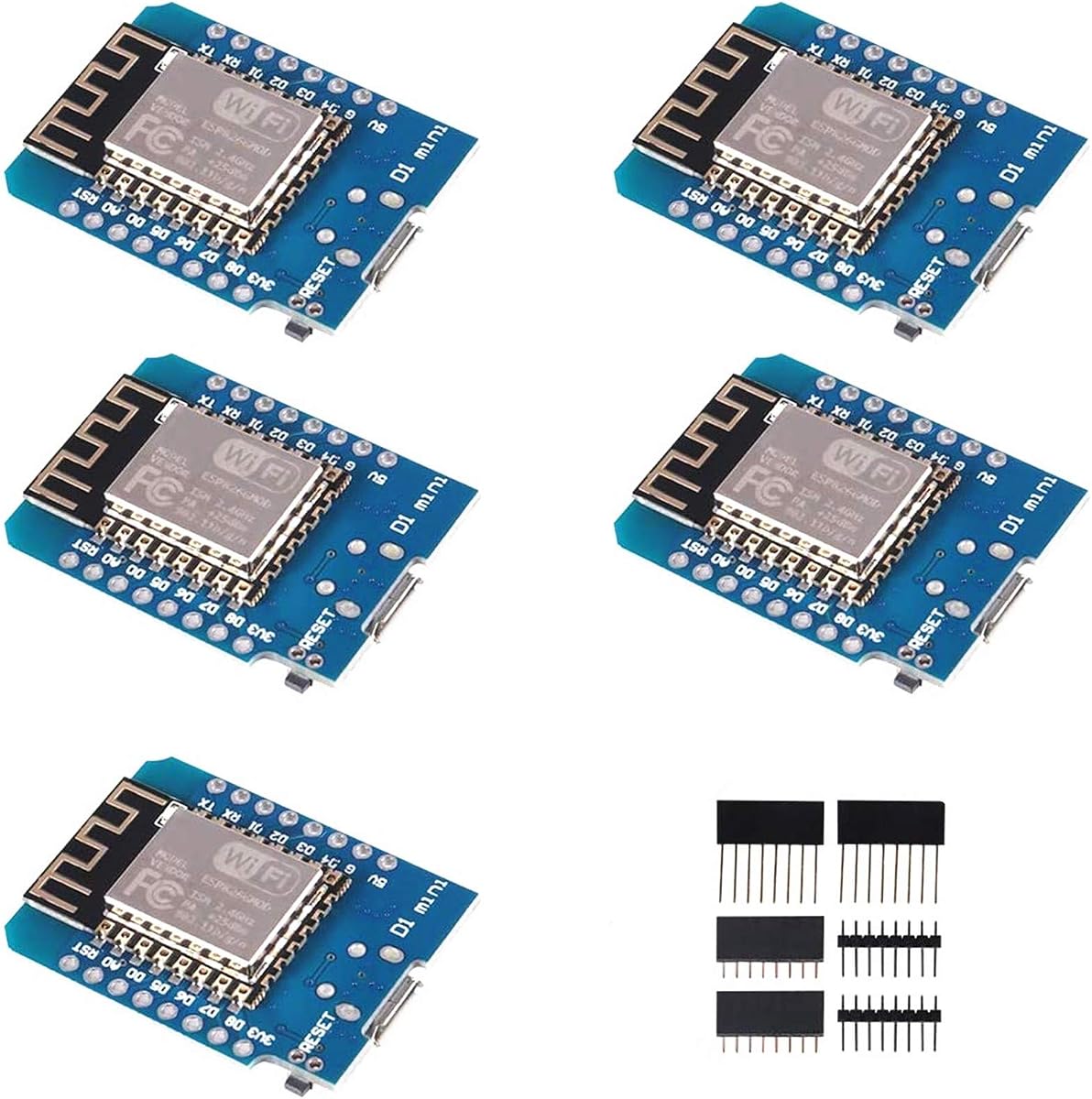
The 5pcs ESP8266 ESP-12 D1 Mini provides a complete NodeMcu package. With a 4.5 rating, it simplifies development with onboard power management.
We may earn a commission when you buy through this link, at no additional cost to you.
It features 11 digital pins and 4M flash storage. This allows for versatile interfacing with sensors. The 5V power supply eliminates the need for external regulators.
Micro USB is less common than USB-C. The onboard fuse limits current which might restrict high-power peripherals. Otherwise, it is a versatile board.
Ideal for compact prototypes needing multiple IO pins. It is a solid choice for learners wanting full GPIO access without extra components.
Integrated switch mode power supply simplifies circuit design.
Abundant digital pins allow connecting multiple peripherals.
We may earn a commission when you buy through this link, at no additional cost to you.
The 10-Pack ESP8266 ESP-01 provides a massive supply for production needs. With a 5.0 rating, it reflects excellent value and consistent quality.
We may earn a commission when you buy through this link, at no additional cost to you.
This quantity is perfect for manufacturing small batch runs. It includes standard LWIP stack support for internet protocols. The compact size suits industrial environments.
It remains a basic module without onboard USB. You must manage power and voltage externally. For bulk buyers, these are standard trade-offs.
Perfect for businesses needing large quantities for deployment. It is the smart choice for scaling projects where every cent counts.
Buying in bulk ensures consistent supply for production runs.
LWIP support allows easy integration with internet protocols.
We may earn a commission when you buy through this link, at no additional cost to you.
Selecting the right WiFi module involves balancing connectivity range, processing power, and power requirements for your specific project needs.
Modern projects benefit from Bluetooth 5.0 or newer Wi-Fi standards. These ensure faster data rates and better range. Consider if your project needs both Bluetooth and Wi-Fi.
Always verify the supported standards match your network environment and device requirements for stable operation.
Dual-core processors offer better performance for complex tasks than single-core ones. They handle data processing and wireless communication simultaneously without lag.
Choose higher processing power if your project involves edge AI or real-time analytics.
Flash memory determines how much code and data the module can hold. Larger memory supports OTA updates and complex libraries. Ensure at least 4MB for flexibility.
Sufficient storage prevents issues when scaling up software features in the future.
Voltage levels like 3.3V are common but require careful power design. Some modules include regulators for 5V systems while others do not. Battery life depends on power efficiency features.
Check current spikes during transmission to design appropriate power delivery systems.
USB-C or Micro USB ports simplify programming and power. Some modules are bare chips needing external converters. Integrated interfaces save space and effort.
Prioritize modules with modern interfaces to streamline development and debugging.
Features like CAN bus or Qwiic connectors allow easy peripheral integration. These simplify wiring for sensors and actuators. Check pinouts for compatible projects.
Expansion features reduce complexity when adding more functionality to your device.
Compatibility with Arduino IDE or MicroPython affects coding speed. Familiar frameworks reduce learning curves. Ensure the module is recognized by your preferred software.
Good software support ensures you can iterate quickly and troubleshoot efficiently.
Basic modules cost less but lack advanced features. Bulk packs reduce unit costs for larger projects. Balance initial cost against long-term performance needs.
Consider total project cost including necessary external components like adapters.
Ensure stable power supply by using regulated sources to prevent brownouts during data transmission. Always check voltage compatibility with your microcontroller logic levels.
Use heat sinks or ventilation for continuous operation to avoid overheating. Keep the module away from metal objects that might interfere with the antenna signal.
Regularly update firmware to patch security vulnerabilities and improve stability. Store unused modules in anti-static bags to protect sensitive components from static discharge.
Yes many options include power-saving modes suitable for battery operation. However you must manage current spikes during transmission to avoid draining batteries quickly. Look for deep sleep capabilities.
Most modules without USB ports need external serial adapters. If you buy standalone chips or bare boards like the ESP-01 they require converters. Integrated boards like Arduino Uno have built-in programming.
ESP32 offers dual-core processing Bluetooth and more memory compared to ESP8266. It is better for complex projects. ESP8266 is suitable for simple tasks and costs less for basic needs.
Yes most products listed are fully compatible with the Arduino IDE. You may need to install additional board support packages for certain models like ESP8266. This enables easy sketch uploading.
Absolutely these modules support HTTP MQTT and other protocols for cloud connectivity. You can integrate them with platforms like AWS or Google Cloud easily. This allows remote monitoring and control.
Typical range varies from 50 to 100 meters outdoors depending on obstacles. Indoor range is often less due to walls. Antenna design and frequency impact performance significantly.
We reviewed ten top options covering various needs from budget-friendly to premium solutions. The Arduino UNO R4 WiFi leads for advanced features while the ESP8266 variants offer great value.
Prioritize your project needs like processing power or connectivity features before deciding. For beginners simple ESP8266 boards work well. For complex tasks consider ESP32 or Arduino boards.
Remember to check current availability and terms before purchasing. Prices and specs may vary slightly over time. Choose the module that best fits your specific development goals.