
Entina Tina2C
4.4Editor score
Start in eight minutes
AI creativity tools
Compact mini design
Explore the top 3D printer for educational use models compared for speed, safety, and ease of use to find the perfect fit for schools and homes.
Finding the right 3D printer for educational use involves balancing speed, safety, and ease of use. Schools and home educators need machines that empower students without overwhelming them with complex calibration or maintenance tasks.
We evaluated ten leading models based on their automation features, safety certifications, print quality, and learning tools. This guide highlights which printers offer the best value for classrooms and STEM programs seeking reliable performance.
Each pick includes detailed specs, pros, cons, and real-world insights into how the device supports learning goals. Prices and availability change frequently, so verify current details before making your final purchasing decision today.
4.4Editor score

4.7Editor score

4.6Editor score
This side by side comparison evaluates the ten most relevant printers for learning environments based on automation, safety, speed, and educational support features.





The Bambu Lab A1 stands out as the top choice for educational settings due to its fully automatic calibration and high-speed precision. It earns a strong 4.7 rating from users who value reliability and ease of use in busy learning environments.
We may earn a commission when you buy through this link, at no additional cost to you.
Its 10,000 mm/s² acceleration enables blazing-fast printing while maintaining exceptional accuracy and detail. The full-auto calibration handles Z-offset and bed-leveling automatically, ensuring optimal performance for every print without manual tweaking.
The main trade-off is that multi-color printing requires purchasing the AMS lite separately, which adds to the total cost. However, this modular approach allows schools to start small and expand capabilities as budgets allow.
Educators seeking a hassle-free, reliable workhorse for students should prioritize the A1. Its combination of speed, precision, and ease of use makes it an excellent foundation for STEM projects and creative learning.
The full-auto calibration system eliminates manual setup, allowing students to focus on design rather than troubleshooting bed levels.
Active motor noise canceling ensures the printer runs quietly, making it suitable for classrooms without disturbing ongoing lessons.
We may earn a commission when you buy through this link, at no additional cost to you.
The Entina Tina2C offers an affordable entry point for schools and families wanting to introduce 3D printing without complexity. It achieves a 4.4 rating for its user-friendly design and strong educational tools.
We may earn a commission when you buy through this link, at no additional cost to you.
It allows users to start their first print in as fast as eight minutes through guided setup and auto-leveling. The Poloprint Cloud app provides AI search, photo-to-print features, and twenty-plus creative modules for STEM learning.
The main limitation is its compact build volume of 3.9 inches, which restricts larger projects. This is acceptable for educational purposes focused on small models and rapid prototyping rather than large-scale fabrication.
For budget-conscious educators prioritizing accessibility and guided learning experiences, the Tina2C is an ideal choice. Its simplicity and rich app features make 3D printing approachable for younger students.
Fully optimized for beginners, the Tina2C allows first-time users to start printing in minutes without technical hurdles.
Photo-to-print and AI search features turn inspiration into tangible models quickly, keeping students engaged in the design process.
We may earn a commission when you buy through this link, at no additional cost to you.
The Ugee Funbox delivers a premium, safe experience tailored for children and educational environments. Its 4.6 rating reflects strong performance, safety certifications, and robust creative tools.
We may earn a commission when you buy through this link, at no additional cost to you.
It features UL GREENGUARD Gold certification ensuring clean air with HEPA and carbon filters. The library includes over 12,000 print-tested toys and the AI engines turn text, photos, or voice into models instantly.
The primary trade-off is the single-color PLA printing limitation, though students learn to assemble multi-color parts manually. This design choice emphasizes safety and simplicity over material versatility.
For schools seeking a safe, high-engagement solution for younger students, the Funbox excels. Its combination of safety, AI tools, and curated content makes it a standout premium choice.
UL GREENGUARD Gold and CPSIA compliance ensure non-toxic materials and clean air for safe student use.
Four AI engines transform simple ideas into printable models instantly, encouraging exploration without requiring design skills.
We may earn a commission when you buy through this link, at no additional cost to you.
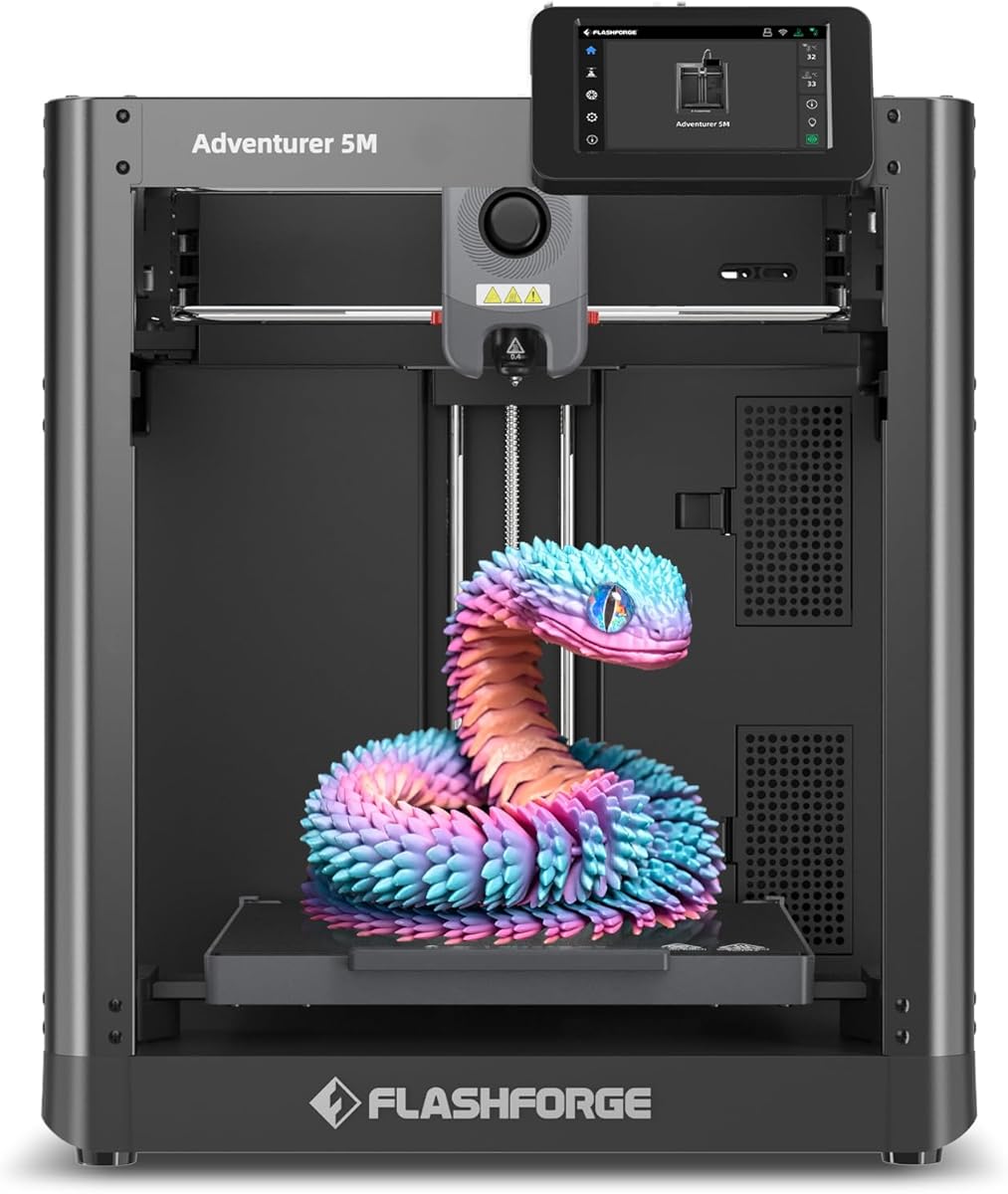
The FLASHFORGE Adventurer 5M offers high-speed performance suitable for rapid prototyping in educational labs. It holds a 3.9 rating, indicating mixed but functional feedback from users prioritizing speed.
We may earn a commission when you buy through this link, at no additional cost to you.
Its CoreXY structure and 600mm/s speed minimize wait times, while automatic bed leveling ensures consistent first layers. Quick three-second nozzle changes simplify maintenance and adaptability for various materials.
The open design lacks enclosure safety features found in premium models, which may limit filament choice for some environments. This is acceptable for classrooms focused on basic materials like PLA.
Educators needing fast turnaround for student projects can benefit from its speed and automation. While user feedback varies, its technical capabilities support efficient educational workflows.
Fast travel and acceleration allow students to iterate designs quickly, keeping pace with classroom schedules.
Real-time app monitoring lets instructors track progress and receive alerts without constant physical supervision.
We may earn a commission when you buy through this link, at no additional cost to you.
The Bambu Lab P1S brings enclosed reliability and speed to educational settings. Its 4.5 rating reflects strong performance for users needing versatility beyond basic plastics.
We may earn a commission when you buy through this link, at no additional cost to you.
The fully enclosed body improves performance for advanced filaments like ABS and ASA. Lightning-fast printing speeds let educators and students focus on creation rather than waiting for prints.
Setting up multi-color printing requires connecting the Bambu Lab AMS, adding complexity and cost. This step is manageable for advanced classrooms seeking expanded material options.
For schools needing a balanced high-performance printer for a range of projects, the P1S is a strong contender. It combines speed, safety, and flexibility effectively.
The enclosed design improves print quality for engineering-grade filaments, expanding learning possibilities for advanced students.
Setup in fifteen minutes ensures the printer is ready for immediate use without prolonged assembly sessions.
We may earn a commission when you buy through this link, at no additional cost to you.
The FLASHFORGE AD5M focuses on reliability and ease of maintenance for educators. It earns a 4.3 rating for its robust build and user-friendly features.
We may earn a commission when you buy through this link, at no additional cost to you.
Fully automatic one-click leveling ensures accurate offsets without manual calibration. The CoreXY all-metal structure provides stable, low-noise performance, while the tool-free nozzle swaps simplify maintenance quickly.
Open design limits use with some high-temp or enclosed-filaments compared to safer options. However, this does not hinder typical educational projects using common materials.
Educators prioritizing straightforward maintenance and reliable prints will appreciate this model. Its combination of speed and practical features supports steady classroom operation.
Tool-free nozzle changes allow quick adjustments without specialized tools, reducing downtime during busy class periods.
Automatic power loss recovery resumes prints from the last layer, preventing waste if electricity fails unexpectedly.
We may earn a commission when you buy through this link, at no additional cost to you.
The Bambu Lab P2S Combo delivers professional-grade multi-color capabilities for advanced educational labs. Its 4.7 rating highlights excellent precision and workflow integration.
We may earn a commission when you buy through this link, at no additional cost to you.
The AMS 2 Pro enables seamless multi-color printing with built-in filament drying. Adaptive airflow balances cooling and retention, ensuring quality across different filament types.
The cost and complexity may exceed needs for introductory classes, making this better suited for advanced makerspaces or design programs.
Schools seeking professional quality and complex print capabilities will find this combo invaluable. It supports high-level projects and detailed prototypes effectively.
The AMS 2 Pro makes vibrant multi-color printing accessible, allowing students to create complex models without manual swaps.
AI failure detection monitors prints and can alert before failures, saving time and materials during long jobs.
We may earn a commission when you buy through this link, at no additional cost to you.
This version of the Adventurer 5M emphasizes rapid setup and high-quality first layers. The 4.3 rating reflects solid performance for general educational tasks.
We may earn a commission when you buy through this link, at no additional cost to you.
Full-auto leveling calibrates the bed perfectly, while vibration compensation eliminates ghosting. Setup takes only ten minutes, allowing quick transition to creative projects.
The open design may require careful filament selection for safety and print stability, limiting some advanced use cases.
Educators needing quick start and reliable prints for daily use will find this model practical. It supports efficient workflows with minimal setup time.
Unboxing to printing in ten minutes ensures minimal downtime, keeping lesson plans on schedule.
The filament sensor halts printing when empty, preventing wasted prints and material waste during long jobs.
We may earn a commission when you buy through this link, at no additional cost to you.
The Snapmaker U1 introduces a unique multi-toolhead system for educational innovation. It holds a 4.5 rating for its advanced features and workflow efficiency.
We may earn a commission when you buy through this link, at no additional cost to you.
The SnapSwap system allows true multi-color and multi-material printing with five-second tool changes. This reduces waste and enables complex functional parts in single prints.
Configuration and costs are higher than typical educational printers, limiting this to advanced or specialized programs.
For institutions seeking to teach advanced manufacturing techniques, the U1 offers exceptional capabilities. It bridges the gap between hobbyist and professional workflows.
Independent toolheads enable mixing rigid and flexible materials, opening possibilities for complex engineering projects.
Tool swapping reduces wasted material compared to traditional methods, supporting eco-friendly educational practices.
We may earn a commission when you buy through this link, at no additional cost to you.
The Bambu Lab A1 Mini Combo offers a compact solution with multi-color capabilities for constrained spaces. It holds a 4.2 rating for balancing size and performance.
We may earn a commission when you buy through this link, at no additional cost to you.
Setup takes about twenty minutes, and full-auto calibration ensures ease of use. The compact size makes it ideal for classrooms with limited bench space.
The smaller build volume restricts large-scale prints but suits most educational models and prototypes perfectly.
Educators needing space efficiency and multi-color options will find this mini version ideal. It retains core A1 features in a smaller form factor.
The small footprint allows deployment on crowded desks or shelves, maximizing classroom utility.
Incorporating AMS lite enables multi-color prints despite the small size, enhancing creative possibilities.
We may earn a commission when you buy through this link, at no additional cost to you.
Selecting the right 3D printer for educational use involves evaluating safety, automation, and learning support features to match your specific classroom needs.
Safety is paramount in educational environments. Look for certifications like UL GREENGUARD Gold which ensure low emissions and non-toxic materials. This is especially important for enclosed models that may heat up or emit fumes during operation.
Prioritize models with enclosed designs and air filtration for student safety in shared spaces.
Automation reduces setup time and frustration for beginners. Features like auto bed leveling, automatic calibration, and power loss recovery ensure consistent results without technical intervention.
Choose printers with full automation to keep students focused on creativity rather than troubleshooting.
User-friendly interfaces and guided setup are critical for educational adoption. Touchscreens, clear instructions, and minimal assembly requirements help students start printing quickly.
Opt for models with quick start guides and intuitive software to support independent student learning.
Fast printing allows for iterative design and rapid feedback. High acceleration and travel speeds reduce wait times, enabling multiple test prints during class periods.
Select printers with high-speed capabilities to maximize learning throughput and engagement.
The print area should match project requirements. Compact units save space but limit larger builds, while larger volumes accommodate ambitious projects but consume more room.
Evaluate typical project sizes to choose an appropriate build volume that balances space and flexibility.
Compatibility with various filaments expands learning possibilities. Ensure the printer supports PLA and other materials you intend to use safely in an educational setting.
Check filament compatibility to support diverse material science experiments and safe operation.
Integrated apps and libraries guide learning. Tools that include model libraries, AI assistance, or guided courses enhance the educational experience beyond basic printing.
Look for software ecosystems that support guided learning and inspire student creativity.
Quiet operation prevents classroom disruptions. Low-decibel printers are essential for schools where noise control is necessary during lessons.
Prioritize models with quiet motors and noise cancellation for comfortable learning environments.
Before starting, ensure the printer is on a stable, level surface. Connect it to power and network if applicable, and load the filament carefully following the manufacturer's instructions.
During printing, monitor progress via the app or built-in camera. Ensure proper ventilation and safety protocols are followed. especially for open frame models.
After use, allow the printer to cool completely. Clean the nozzle and build plate regularly to maintain print quality. Store filament in a dry place to prevent moisture absorption and degradation.
The Ugee Funbox is top rated for safety with UL GREENGUARD Gold certification, HEPA filtration, and enclosed design. It minimizes fumes and risks for children learning at home or school.
The Entina Tina2C can start a print in as little as eight minutes. Its automated setup and guided app reduce preparation time significantly for busy educators.
Auto calibration removes manual bed leveling and Z-offset adjustments. Students get consistent prints without technical troubleshooting, keeping them focused on design and creativity.
They expand creative options but require more setup and filament management. For advanced classes, they are invaluable, but beginners may start with single-color models to simplify learning.
Compact build volumes like 3.9 inches suit small models and save desk space. Larger volumes like 220mm work for bigger prototypes but require more room in classrooms.
Many offer offline modes and SD card printing to work without internet. Apps enhance features but most basic functions work locally for offline classroom environments.
The Bambu Lab A1 offers the best overall balance of speed and automation for schools. Budget-conscious options like the Entina Tina2C provide accessible entry points with rich learning features.
Safety and ease of use should guide your selection. Prioritize models with strong safety certifications, automated calibration, and intuitive software to ensure a positive experience for all students.
Prices and availability shift frequently so verify current details and stock before finalizing purchases. With careful selection, a 3D printer can transform your educational program into an innovative learning hub.